Effective Intranet Management 2010

At the last minute, I got called in to give a presentation at the Ark Group’s Effective Intranet Management conference. Fortunately I had already prepared a small truckload of material for BarCamp Canberra. The presentation was a combination of three things:

  1. Some preliminary results from OzCollab.
  2. Revisiting the idea of information ecology – esp. the contents of Tom Davenport’s 1997 book. This book should be required reading for intranet/information/knowledge managers. It only seems to be getting more relevant.
  3. A very quick 5 minute blast of ideas around cyborg metadata. There are references to CURLS, the Powerhouse Museum‘s use of Open Calais, Luis Von Ahn‘s GWAPs, Imense & Tagmotion.

When we find the time, Keith & I will probably take OzCollab to some new places. The cyborg metadata concept will be fleshed out in a series of articles over the coming year (the first to appear in a week or so).

Posted in Presentations & Events | Tagged | Leave a comment

Wicked

Anne “Metamurf” Murphy & myself put in a proposal for a deliberative democracy project with an Australian state government agency. We didn’t get the gig but I was mighty pleased with the proposal (& I am rarely pleased with my proposals). So Anne & I took out much of the situation specific detail and turned it into the following short paper. It’s an attempt to meld our mutual interests into something more than the sum of their parts. If you don’t recognise a term, then try here.

Have a read and tell us what you think.

Read Wicked here

Posted in Articles & Papers | Tagged , | 13 Comments

New Book on KM, L&D & OL: Call for Involvement

Performance Enhancing will be my first book, scheduled for release in early 2010. It will make the case for the integration of Knowledge Management, Learning & Development & Organisational Learning. I had originally conceived it as simply a longer version of this article but it’s turning into more than that. It will also be the first book from Innotecture Press.

At the moment, I am interviewing people and collecting some case studies. In January next year, I’ll need readers / reviewers. If you want to be involved  then please email me.

Here is the background for case studies:

Case studies should be examples of organisations using a mix of learning & development, organizational learning and/or knowledge management techniques to enhance their performance.

The case studies can be any length and they will be incorporated in the text rather than standalone chapters. I cannot offer money for them but contributors will keep copyright of their material (they’ll in effect be licensing it to me) & can do what they like with their own case study material. The main benefit for contributors will be publicity.

Suggested format:
1. Organisational Background – Who is the organisation? When & where is being discussed?
2. Challenge – Why was the effort initiated?
3. Approach – How was the effort carried out?
4. Outcomes – So what was the result of the effort? Includes qualitative & quantitative outcomes.
5. Reflections – What worked well? What could be done differently?

Deadline: Friday January 8 2010.

Posted in Books | Tagged | 3 Comments

Nancy White Redux

Nancy was here. We know this because of the blog, Jeanne Walker’s Flickr stream and also the damn awesome events that Nancy ran.

  • The Sydney Facilitators Network gig was excellent. As much as the world of facilitation drives me up the wall sometimes (“tell me what you think”), that crowd are up for anything. And the group and Nancy just fed off each other’s energy.
  • The morning of the Sydney online communities gig was great. We had a small number of people from a reasonably homogeneous background and we just sat and chatted about important stuff.
  • The Sydney afternoon just didn’t quite gel until towards the end. We had a very diverse bunch of participants and on reflection Nancy & I tried to overdesign the session. Sometimes less is more.
  • The KMLF meeting and subsequent Chinese restaurant nonsense was good. In some ways more restrained than the Sydney Facilitators but still powerful.
  • The Melbourne morning and afternoon online communities sessions were just great. The participants were totally engaged, the format gave people just enough structure and at the end we had to forcibly eject some people to make our planes. One point of contrition – I spent too much time fiddling with the video camera & pottering round the edges. Need to work on being more present.

Thank you to everyone who made this happen! 2010 will be interesting indeed…

I want to get Nancy back over here in 2010.

Posted in Presentations & Events | Tagged | Leave a comment

SI KM Leaders Call – Using Expertise

The slides can be downloaded from slideshare. Download the audio.

UPDATE: Download the SI KM Leaders call mp3. Many thanks to everyone who participated – and my apologies for being late (I was literally holding the baby).

ANOTHER UPDATE: Patrick’s presentations @ KM World 2009.

Links:

Posted in Projects | Tagged , | 3 Comments

Conference Redux

From the lack of posts here, it may seem that I’ve been slack. In fact I’ve been busy with paid work and the public outings that I have done haven’t necessarily involved presentations & notes. I thought I’d just note what these were:

If you enjoyed any of these events and would like to catch for a coffee then don’t be shy – drop me a line!

Posted in Presentations & Events | Tagged , , , , | Leave a comment

actKM Conference 2009 – Mapping KM

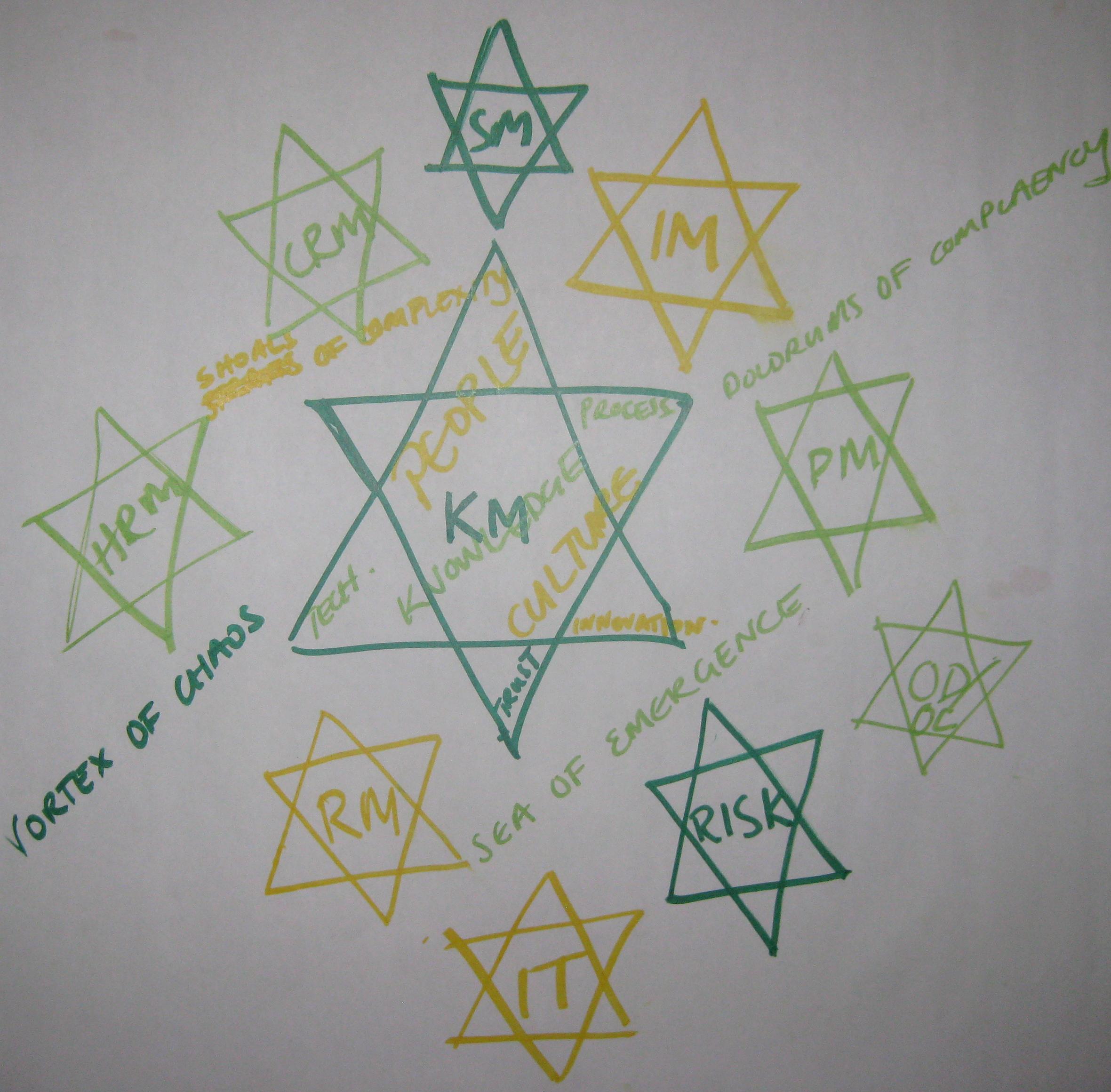
I’ve not done a lot of presentations recently. I’ve preferred to do something a little more “interactive”. So when the call for papers came out for actKM 2009, the last thing I wanted to do was a paper. Instead I was interested in exploring the edges of knowledge management. I wasn’t really sure how to do that but I had something in the back of my mind from the Mindell’s process work. This can involve exploring psychological “edges” using physical movement and other techniques. So I dipped my toe in the water and sent out a question to the actKM email list concerning disciplinary boundaries. The response I got back wasn’t particularly helpful and this indicated that I couldn’t do anything too confronting.

Then the thought struck me. Get the participants to draw maps. So that’s what I did. Six tables, six maps. In each case I asked them to map out knowledge management as an imaginary nation and then identify who else this nation might interact with (through trade, war or something else).

Some comments:

  • “Finance” crops up as an ambiguous/hostile power is a couple of maps – and as the “Resource Shark” in another.
  • Some of the maps are a little idealistic – how things should be rather than how they are.
  • One of the maps positions KM’s neighbours as process-based – e.g. six sigma, BPM, Lean, TQM.
  • One group had the occasional KM guru on the map – but up a mountain separate from practitioners.
  • Technology is often mentioned but rarely given centre-stage.
  • One group started identifying KM’s neighbours (e.g. Project Management, Organisational Development) without any prompting but others took a more KM-centric perspective.

What do you see?

Posted in Presentations & Events | Tagged , , | 19 Comments

Sydney Sharepoint User Group: Taxonomies & Sharepoint (Tuesday 18 August)

Here are the slides & notes for a presentation I gave last night to the Sydney Sharepoint User Group on the topic of Sharepoint & Taxonomies. The presso is basically in 3 sections.

Slides 2-14: Introduction to Taxonomies

I started off by asking the audience how they might group wine together (or classify it) – the answers included colour, variety, vintage, region, bottle shape, sweetness. Then we had a look the way a wine shop orders them. The point here (apart from giving Brendan a bit of a plug) is that there are many ways to group things – and some of the most useful ones for users/consumers are not necessarily obvious from the object itself. Hierarchies & facets were then discussed via the systems of Dewey* (Dewey Decimal) and Ranganathan (Colon Classification) and some real-world examples.

The “we don’t need structure, we just need search” comment also got a mention – which resonated with a few people in the audience. The answer(s) to this include: i. taxonomies & metadata can make search better & ii. taxonomies & informtion mapping are about more than just findability. We ended that segment with Patrick‘s taxonomy map.

Slides 15-25: Taxonomies in Organisations

This section could be represented by a 3 x 3 matrix – who is involved in taxonomies vs what they are doing. I split the “who” into 3 broad groups:

  • Experts – and here I mostly mean taxonomy experts but it could also be subject matter experts.
  • Machines – language processing / semantic software (but this could also include process automation software as well).
  • Users – general people who just do, y’know, stuff.

You need to involve all 3 groups but each has their strengthens & weaknesses. And then I tackle 3 broad activities:

  • Building a taxonomy (or folksonomy or ontology).
  • Applying terms to documents.
  • Consuming – which in this situation means doing things with documents based on their metadata. This could as simple as someone searching & finding something or some fancy processing based on an ontology.

Slides 26-37: Sharepoint

Sharepoint’s basic methods of managing metadata are:

This is a good start but Sharepoint has three main deficits:

  • It doesn’t handle hierarchical relationships between terms in lists well – it treats each list as though it is independent.
  • Metadata can easily get caught in site “islands”.
  • It doesn’t do any of the fancy machine classification.

A range of third-party vendors have arisen to meet these needs – each offering very different functionality at varying costs.

*I don’t know whether to be offended or impressed by Dewey’s classification of Australia with extra-terrestrial worlds.

Posted in Presentations & Events | Tagged , , | 4 Comments

Research News – Storylistening for Consumer Insight

A recent poll stated that women spend 52 minutes a day gossiping – and before the men start sniggering, apparently they spend an average of 76 minutes daily spinning yarns with their mates. We tell stories to each other compulsively – to make sense of our experiences, to persuade others, or even just to entertain ourselves. Despite the prevalence of stories in our lives, we often don’t know what to do with them in more formal situations.

A short article on story & narrative in the AMSRS publication Research News. Here is the link to the site or the article for download.

[N.B. I should be clear here that I am not a market researcher]

Posted in Articles & Papers | Tagged , | 1 Comment

Collaboration in Australia

Are you currently using collaborative software, or are you planning to acquire it? Would you like to benchmark your experience against that of others? Are you based in Australia?

We are researching the use of collaboration tools in Australia. “Collaboration” is a buzz term at the moment, and we want to get behind the hype to discover how organisations are selecting and implementing tools and whether they are benefiting from them. If you have experience with selecting, implementing or maintaining a collaboration tool within the last 12 months then we would like you to take part in this survey. The survey is open from Monday 22 June 2009.
What’s in it for me?
You will receive a free summary overview of the survey results from all participants. You can compare your situation with others and learn from their experiences in:
  • Identifying the range of tools;
  • Selecting and implementing them;
  • Realising benefits;
  • Using consultants and other service providers.

We will combine these survey results with key vendor interviews, case studies and further research to provide the first authoritative overview report of the Australian Collaboration Technology Landscape. As a participant in the survey, you will be eligible for a copy of this report at a discount.

About the survey

This survey is being conducted by Matthew Moore, Director, Innotecture and Keith De La Rue, Principal Consultant, AcKnowledge Consulting.
All survey data collected will be anonymised before the publication of any reports.

Please fill out the survey at http://tinyurl.com/ozcollab now!

Matthew Moore
Keith De La Rue
Posted in Projects | Tagged , | Leave a comment