IM Clinic & ECM3 Survey

In late March 2011, we will be running an Information Management Clinic with AcKnowledge Consulting in Melbourne. This is  a session focused on information “pain relief”and practical problem solving.

In conjunction with this event, we are running an Enterprise Content Management maturity assessment survey based on the open source ECM3 methodology. It should take you 10 minutes and you will be in the running for some nifty Apple technology. Summarised results will be available under a Creative Commons license. So please take the survey and let us know what’s going on!

Posted in Projects | Tagged , | Leave a comment

Taxonomy Usage and Skills by Australian Information Professionals

Innotecture and Straits Knowledge conducted a survey on taxonomies in Australia. The survey investigated the use of taxonomies by Australian organizations and the taxonomy skills of Australian information professionals. 125 information professionals responded. The responses indicated a strong desire to employ taxonomies more effectively and a need to demonstrate the business value of taxonomy work to organizational decision makers.

Download the article here.

Australian Taxonomy Workshop 2011

Posted in Articles & Papers | Tagged , | 2 Comments

actKM 2010 – Performance Enhancing

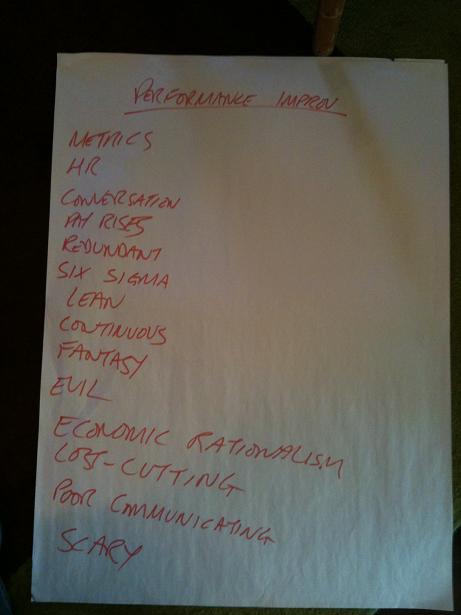
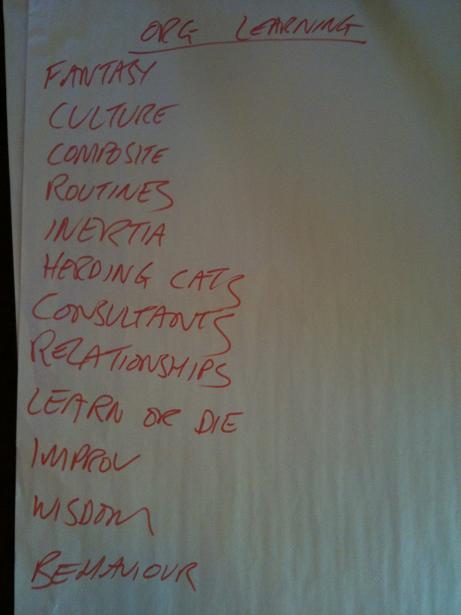
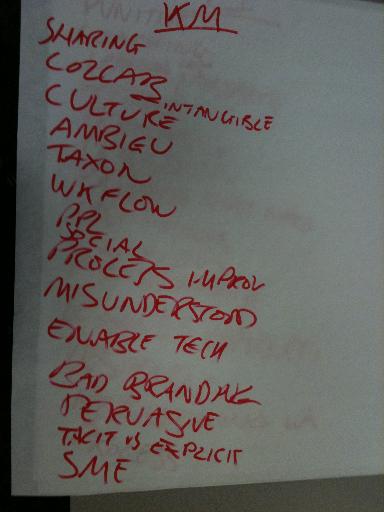
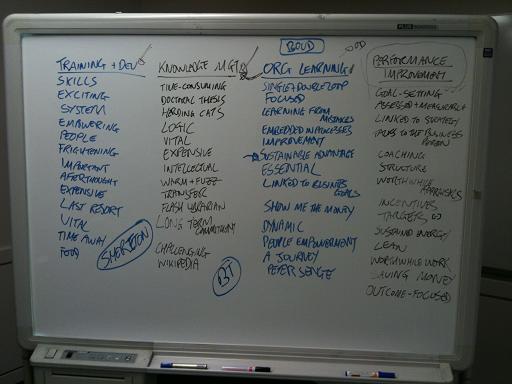
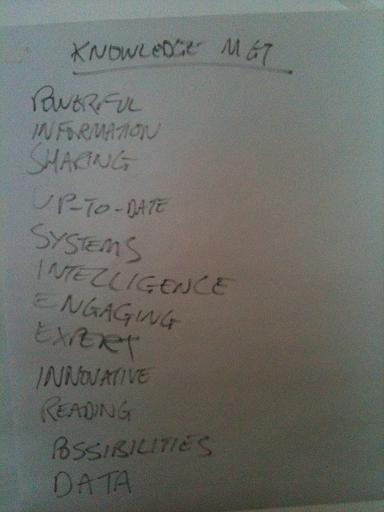
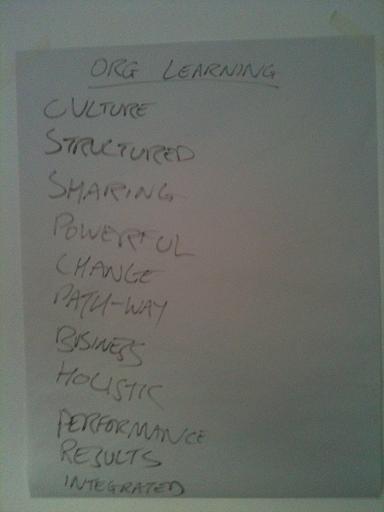
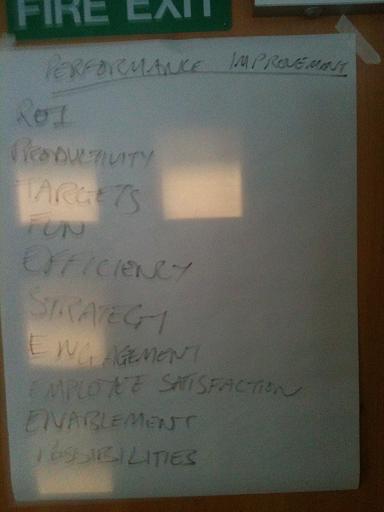
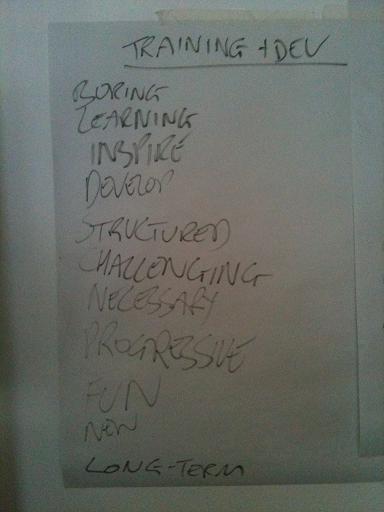
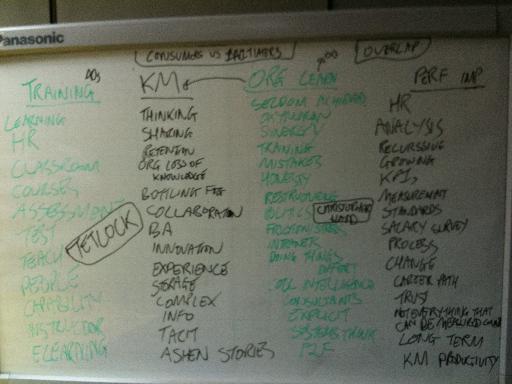
You had to be there. Seriously. There were no powerpoints, no notes to take away. We did the word association game (results below) which you can compare with these, this & this.

I suppose I’d better mention the book eh?

Posted in Presentations & Events | Tagged , | Leave a comment

Taxonomy? Show me the money first!

Are Australian organizations ready to take advantage of the semantic web and master data management? A recent survey shows that while we are on the right track, we need to get better at demonstrating the business value of taxonomies and metadata:

  • Nearly three quarters of respondents are using some form of taxonomy to manage their information.
  • Only 13% were happy with their use of taxonomies and related tools.
  • However many respondents stated that they lacked the resources to improve. In particular, information professionals struggle to present a compelling business case to decision makers.

Organizations who wish to make their documents and data accessible externally or internally need to use consistent metadata standards and vocabularies. Taxonomies form a critical part of this information governance process. Innotecture and Straits Knowledge will be providing a workshop in Sydney in March 2011 that will enable attendees to run their own taxonomy projects and provide the business justifications for doing so.

Background

The Australian Taxonomy Use & Skills Survey was conducted online by Innotecture Pty Ltd and Straits Knowledge in late 2010. 125 Australian information professionals responded. These included IT managers, information architects, knowledge managers, records officers and librarians. Survey respondents worked in the public, private and not-for-profit sectors. Innotecture is an Australia-based information management consultancy. Straits Knowledge is a Singapore-based consulting and research firm focused on knowledge, learning and innovation. Straits Knowledge founder Patrick Lambe is the author of Organising Knowledge, a pioneering book on the strategic importance and business value of taxonomy development for organizations.

Posted in Projects | Tagged , | Leave a comment

SharePoint for Information Professionals

Microsoft’s SharePoint product has become one of the most popular tools for content management and document-centred collaboration in business and government over the last five years. This article outlines what the product does, its benefits and limitations and its broader ecosystem including third-party products. It also outlines the important role that information professionals can play in the effective deployment of SharePoint within organisations. It ends with three recent Australian case studies (New South Wales Department of Education and Training, the Ambulance Service of New South Wales and John Holland) where SharePoint and related technologies have been used to improve workplace productivity.

Download the article here

Posted in Articles & Papers | Tagged | 1 Comment

Oz-IA 2010: Welcome to the Jungle

Some links:

Posted in Presentations & Events | Tagged , | Leave a comment

Australian Taxonomy Use & Skills Survey

We would invite you to respond to the Australian Taxonomy Use & Skills survey.

It has the following purposes:

  • To understand the use of taxonomies by Australian organizations;
  • To identify the current taxonomy skill levels of Australian information professionals; and
  • To identify opportunities for taxonomy skills improvement.

All respondents who leave an email address will:

  • Receive a copy of the aggregated results; and
  • Be entered into a prize draw for a free copy of Organising  Knowledge.

The survey is here: http://www.surveymonkey.com/s/oztaxom

Survey closes: Wednesday October 20th.

Posted in Projects | Tagged , | 2 Comments

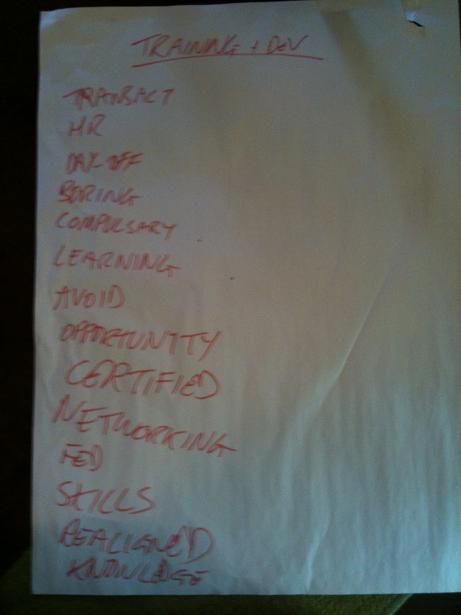
Performance Enhancing – Word Association

There is a game I have been playing with people around the world. It’s a very simple game called “word association”. I write up some phrases and then people tell me what comes into their heads. The phrases are “training & development”, “knowledge management”. “organizational learning” and “performance improvement”. The results from groups in Christchurch (NZ), Wellington (NZ), Melbourne (Aus), Chicago (US) and London (UK) are available below.

Sadly you get no sense of the splendour of these cities and the uniqueness of the people in them, you just get pictures of white boards or flipchart paper. Have a browse. My thoughts will follow in the next post.

Posted in Books, Presentations & Events | Tagged | 1 Comment

Performance Enhancing – Am I on my own?

It would be very tempting to say that I am the sole visionary with something to say about combining learning and knowledge for Performance Enhancing. However that would be completely untrue. In researching and writing the book, I found that I was far from alone.

  • The Internet Time Alliance come at this terrain from a training and elearning background. I found myself nodding vigorously as I read Charles Jenning‘s articles. Jay Cross‘s Informal Learning is basically about good knowledge management as far as I am concerned.
  • Marcia Connor has been exploring similar territory for some time although she has joined the Altimeter Group.
  • Victor Newman* has been looking at knowledge and learning through the lens of strategy and innovation for the past decade.
  • Coming from more of a KM perspective, Nick Milton and Ron Young have both written about the links between organizational learning and knowledge management from a practitioner perspective.
  • Academics such as Mary Crossan, Davide Nicolini and Mark Easterby-Smith have been writing about the links between organizational learning and knowledge management since the 1990s.
  • The APQC has also reported on organizations that care combining knowledge management with training activities.

Nevertheless, many organizations do not see the connections between knowledge and learning issues. We need to move beyond traditional course-based training and document repositories if we are to get more bang for our buck.

*Since my wife has been exposing me to more day-time TV, I have discovered there is another Victor Newman.

Posted in Books | Tagged | Leave a comment

Performance Enhancing – So what’s the book about?

When I tell them about the book, people ask me: “What’s it all about then?”

There isn’t just one answer to that question but here are a selection of contenders for your consideration:

  • It’s about getting more bang for your buck. Organizations spend a lot of money on training and knowledge management. They often get some benefit from these activities but it is my belief that they can get more. The book is a plea for organizations to tackle knowledge and learning issues in a holistic way in order to do them better.
  • It’s about mixing of practice and theory. It wouldn’t pass muster as an academic tome but I’m actually quite happy with that. There are plenty of examples and case studies to illustrate points but there’s also some references to the the theoretical background concerning learning and knowledge issues in organizations.
  • It’s the book that I wished that I had had when I started out in knowledge management back in 1999. I would probably have made as many mistakes as I actually did – but possibly more interesting ones.
Posted in Books | Tagged | Leave a comment